Spring has sprung–Happy May! Here is a peek into some Lower and Middle School artworks.
Student ART Portfolios
Please be on the look out toward the end of the school year. Your child (K–8) will be bringing home a collection of their artwork in a portfolio!
Kindergarten
HOT DOGS, COOL CATS: George Rodrigue was born and raised in southwest Louisiana, “Cajun Country,” George Rodrigue preserved on his canvas what he feared was his dying heritage — including its land, people, traditions and mythology. It was a Cajun legend, the loup-garou, that spawned his most famous series, The Blue Dog. Kindergarten students learned about artist George Rodrigue and his creation of Blue Dog. After reading, Why is Blue Dog Blue? Students created their own inspired warm and cool dog and cat composition and after we discussed color schemes and color temperature.
CLAY TEXTURED OWLS: In clay, students sculpted and made textured hanging owls in honor of our school mascot. Using a variety of hand-building skills along with a variety of tools-including dry pasta to imprint texture and designs!
MIXED 2D & 3D ART: In the beginning, there were three colors . . .Reds, Yellows, and Blues. All special in their own ways, all living in harmony―until one day, a Red says “Reds are the best!” and starts a color kerfuffle. When the colors decide to separate, is there anything that can change their minds? A Yellow, a Blue, and a never-before-seen color might just save the day in this inspiring book about color, tolerance, and embracing differences. After reading the story students created 2D artworks using the primary and secondary colors–creating their mixed characters! Afterwards, we sculpted 3D Mixed figures.
First Grade
JOAN MIRÓ MAGICAL CREATURES: Joan Miró was a Spanish artist famous for combining abstract art with surrealism. He worked in a variety of media. Not only did he produce paintings and drawings, his body of work includes collages, murals, tapestries, and sculptures. Students took inspiration from Miró’s body of work and created their own combined abstract-surrealist figure highlighting a variety of symbols in the style of Miró.
PICASSO PEACE BOUQUET: Pablo Picasso, Bouquet of Peace, 1958, displays a simple design of flowers with a significant message, Pablo Picasso Bouquet of Peace, 1958 expresses the poewr and beauty Picasso utilizes in his works. This work was created by Picasso for the peace demonstration held in Stockholm, July 16-22, 1958. Students took inspiration and created their own spring bouquet– adding flowers by mixing primary colors into secondary colors.
ALMA THOMAS INSPIRED RADIAL DESIGNS: Alma Woodsey Thomas was an African-American artist and teacher who lived and worked in Washington, D.C., and is now recognized as a major American painter of the 20th century. Thomas is best known for the “exuberant”, colorful, abstract paintings that she created after her retirement from a 35-year career teaching art at Washington’s Shaw Junior High School. Students took inspiration from Thomas’s work and created these wonderful radial designs.
Second Grade
GUSTAV KLIMT: After learning about artist Gustav Klimt, Austrian symbolist painter, second grade students took inspiration from his famous Tree of Life Stoclet Frieze and created their own. The painting is based on the Art Nouveau style including Klimt’s signature patterns, design elements and of course gold!
PAUL KLEE, CAT and BIRD: Cat and Bird is a painting by Swiss German painter Paul Klee, created in 1928. It was made when Klee was a teacher at the Bauhaus Dessau. The painting depicts the wide face of a stylized cat with a small bird perched on its forehead. It is held in the Museum of Modern Art, in New York. Students examined Klee’s work and created their own composition focusing on symmetry and balance.
Third Grade
NATIVE AMERICAN INSPIRED WEAVINGS: According to Navajo tradition, weaving is the most ancient and sacred practice of their people. Two spirits, the Spider People, brought hemp seeds to the Navajo. Spider Man taught them to make the loom, while Spider Woman taught them how to weave so that they could always provide for themselves. Third grade students took inspiration from this tradition and created these wonderful woven wall hangings.
CLAY “SLAM” TRAYS: Third grade explored texture by creating a clay slam tray that they then used patterned textured plates and a variety of pasta to form impressions and designs in the clay. After they were bisque fired students added three coats of glaze–fired again into these colorful creations of form and function!
Fourth Grade
CHINESE SCROLLS: A hanging scroll is one of the many traditional ways to display and exhibit East Asian painting and calligraphy. The hanging scroll was displayed in a room for appreciation; it is to be distinguished from the handscroll, which was narrower and designed to be viewed flat on a table in sections and then stored away again. Students used sumi brushes and ink to create these wonderful cherry blossom tree scroll designs.
CLAY WALL POCKETS: Students created beautiful clay wall pockets demonstrating form and texture. Building on past hand-building techniques students learned how to attach a pocket and add a support to keep the structure intact while it dried. Using texture plates along with a variety of dried pasta shapes they added textural designs and patterns. After they were bisque fired students added three coats of glaze–fired again into these colorful creations where form meets function!
Fifth Grade
JAPANESE KOI FISH: Koi fish (Cyprinus carpio), a domesticated ornamental carp, originated from wild carp in East Asia, with early domestication for food tracing back to China as early as the 4th century CE. Modern colorful koi, or nishikigoi, were developed in the early 19th-century Niigata region of Japan, where farmers selectively bred natural color mutations from simple food fish into the “swimming jewels” known today. Students took inspiration from these beautiful fish and created their own magical koi pond paintings.
JAPANESE CLOISONNÉ DESIGNS: Cloisonné are metallic objects made with intricate designs and artwork which have been a unique piece of art and creativity since ancient times. It is a unique way of designing metal objects with gemstones, glass materials, enamel paints and other decorative objects which make this art an edge over other handicraft materials. The decoration on the metal objects by initially adding comparisons to the metal objects with gold and silver wires. Once the soldering is done, they are finalized with enamel paints and then they are fired in a kiln. This piece of art has existed since ancient times and has been as old as since 13 century BCE.
Sixth Grade
ALBERTO GIACOMETTI SCULPTURES: Giacometti was born in Borgonovo, Switzerland in 1901. He was really creative and he went to art school in Geneva, Switzerland and Paris, France. He is best known for making large, thin sculptures of people. Giacometti captured movement in his sculpture. It often looks like people have been frozen in time. He was inspired by Cubism (an abstract art style which often shows people from lots of different angles) and Surrealism. Giacometti was one of the most important sculptors of the 20th century. Students took inspiration from these sculptures and created their own dynamic poses. They started with a wire armature, foil to add tone and muscle and finally plaster of paris to act as the skin. The final touch was a dry brush technique of black and bronze paint to create the illusion of metal in which many of Giacometti’s sculptures were cast.
PETER MAX INSPIRED POP ART STATUE OF LIBERTY: Peter Max is a German-American artist known for using bright colors in his work. Works by Max associated with the visual arts and culture of the 1960s, particularly psychedelic art and pop art. Students examined Max’s depiction of the Statue of Liberty. As we approach the 250th celebration of the United States students learned about the artist and famous architectural landmarks, created their own versions and added vivid pop art colors!
Seventh Grade
MIXED-MEDIA CLAY LOOMS: Students started with a discussion on the uses of the first weavings (fishing nets, blankets, baskets, rugs, clothing). They then looked at examples of clay looms with themes. Some looms had circular weavings, others had a linear design. Unlike a traditional loom, the weaving in these works is meant to be permanent. Students created a textured clay slab into a loom. Next they will weave a design into the center choosing color fibers to complement their looms. The final touch is a wire hanger to display them!
MATISSE PRINTS DU SOLEIL: Students created stand-out Heliographic prints using organic paper shapes, vibrant liquid watercolors, and sunshine. Discovering how varying areas of exposure to the light create stunning patterns. Looking closely at Matisse’s work, and inspired by his cut-paper shapes, they used sunlight to create their own color-saturated Heliograph prints on muslin fabric.
Eighth Grade
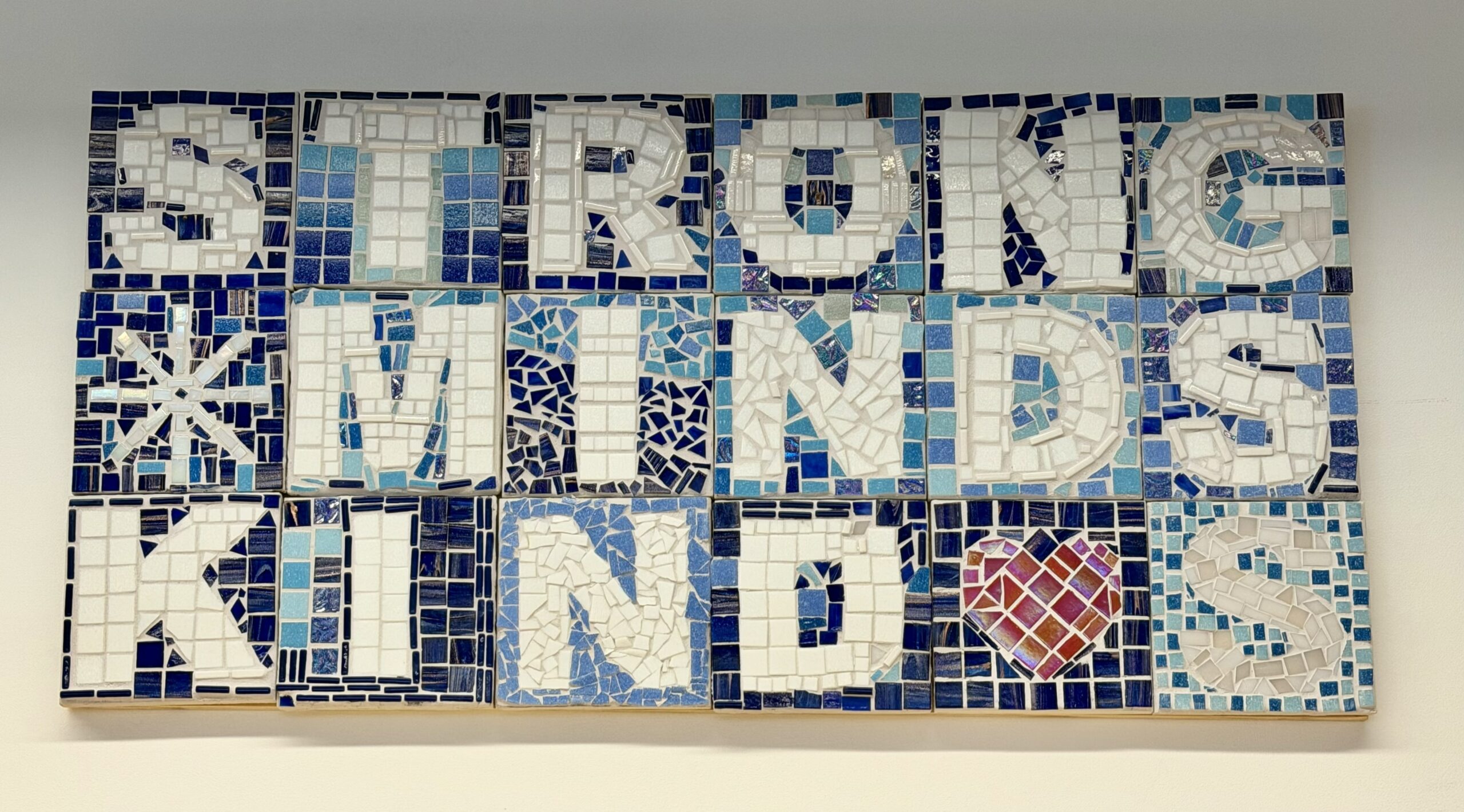
Class of 2026 COLLABORATIVE MOSAIC: Mosaic art originated over 5,000 years ago, using shells, and stones for decoration. Greeks refined this into detailed pebble scenes, while Romans popularized durable tesserae floors across their empire. Byzantine artists later moved mosaics to walls and ceilings, utilizing gold glass to create luminous, spiritual, and lasting imagery. Each year the graduating class creates a Legacy Art Project leaving their mark and beautifying our campus! Looking across all grade-levels in art history mosaics have stood the test of time. This year students created a mosaic installation of our school motto, STRONG MINDS, KIND HEARTS. The class worked diligently bringing this creation to fruition. It is proudly displayed in the Fanger building greeting students, faculty and families.
CLAES OLDENBURG POP ART FOOD SCULPTURES: Grade 8 learned about artist Claes Oldenburg a Swedish-born American sculptor, best known for his public art installations typically featuring large replicas of everyday objects. Students were tasked to select a “pop art” food item and engineer how to bring it to life!
GOOD LUCK GNOMES: To celebrate their graduation students created Good Luck Gnomes. Using traditional clay hand-building techniques each student successfully created a unique and clever gnome figure sculpture. These gnomes are meant to hold deep meaning, symbolizing protection, good luck, prosperity, and hard work!