
“Creativity takes courage.” – Henri Matisse.
Here is a peek into some Lower and Middle School art installations around campus.
Kindergarten
MARY BLAIR-INSPIRED CASTLES: Mary Blair was an American artist, animator, and designer. She was prominent in producing art and animation for The Walt Disney Company, drawing concept art for such films as Alice in Wonderland, Peter Pan, Song of the South and Cinderella. As students studied Kings and Queens in the classroom–in art they focused on architecture and castles. Studying shapes and creating these inspirational Mary Blair designs.
First Grade
VINCENT VAN GOGH IRISES: Students learned about artist Vincent van Gogh and his series of iris flower still lifes. Students took inspiration and created their own symmetrical iris flower. After applying paint and folding the paper to duplicate the image on the other side creating the petals of the flower.
HENRI MATISSE-INSPIRED SNAILS: The first graders created these mixed-media collage snails inspired by the abstract artwork The Snail by Henri Matisse. It consists of a number of colored shapes arranged in a spiral pattern, as suggested by the title. The Snail is a major example of this final body of work. The piece is in the Tate Modern collection in London.
Second Grade
SOUTH AMERICAN MOLAS: As second grade students were learning about South America in the classroom, in art they learned about Molas. A hand-made textile that forms part of the traditional clothing of the indigenous Guna people from Panamá, Central America, Colombia, and South America. Here students took inspiration and simulated the many stitched layers of the Mola using layered paper designs.
GUATEMALAN WORRY DOLLS: Worry dolls are small, hand-made dolls that originate from Guatemala. According to legend, Guatemalan children tell their worries to the Worry Dolls, placing them under their pillow when they go to bed at night. By morning the dolls have gifted them with the wisdom and knowledge to eliminate their worries.
Third Grade
HOPI KACHINA DOLLS: Hopi figures, also known as kachina dolls, are figures carved, typically from cottonwood root, by Hopi people to instruct about katsinas or katsinam, the immortal beings that bring rain, control other aspects of the natural world and society, and act as messengers between humans and the spirit world. Students respectfully took inspiration and applied a multitude of elements and principles of art to construct their own spirit doll.
UKRAINIAN PYSANKY EGGS: Pysanky as plural—is derived from the Ukrainian verb pysaty, which means “to write,” or in Ukrainian. So in this case, the word refers to the writing on the eggs. While many Christians might be familiar with dying Easter eggs with solid colors, Ukrainian Easter eggs often feature complex geometric and floral designs. After learning about these traditions students created their own inspired 2D version using the Ukrainian symbols and colors in their designs.
Fourth Grade
AFRICAN-INSPIRED MASKS: Fourth grade students looked at a variety of African works of art, such as masks used in ceremonies for planting, harvesting, or hunting. Becoming familiar with examples of art from specific regions and peoples in Africa, such as Antelope headdresses of Mali, Sculptures by Yoruba artists in the city of Ife and Ivory carvings and bronze sculptures of Benin. Creating their own mask using symmetry and patterns.
Fifth Grade
WARM AND COOL AZTEC SUN RELIEFS: In the classroom, students were studying the Mayan, Aztec, and Inca Civilizations. The Aztec or Mexica calendar is the calendrical system used by the Aztecs as well as other Pre-Columbian peoples of central Mexico. It is one of the Mesoamerican calendars, sharing the basic structure of calendars from throughout ancient Mesoamerica. In the art room, students created a painted cool color background and added a clay relief sculptural warm Aztec sun design to symbolize the ancient Aztec calendar. Adding many details and textural qualities really brought these creations to life!
M.C. ESCHER TESSELLATIONS: Fifth grade students created tessellation designs using combined geometric and organic shapes with no overlaps and no gaps inspired by mathematical artist M.C. Escher. Once their tessellation was constructed they had to creatively turn the shape into something unique!
Sixth Grade
NON-OBJECTIVE REPOUSSÉ DESIGNS: Repoussé (French) is a metalworking technique in which a malleable metal is shaped by hammering from the reverse side to create a design in low relief. Chasing or embossing is a similar technique in which the piece is hammered on the front side, sinking the metal. Sixth grade students created a non-objective design in the metal and then had to expand the design into the border.
ROCOCO-INSPIRED NEEDLE FELTED SPRING EGGS: Rococo art, by nature, was elaborate, playful, filled with delicate colors, and often witty. Rococo is an artistic style which originated in the 18th century in France. Students created these wonderful Rococo inspired spring eggs using the art of needle felting. Needle Felting is the process of transforming wool into 3D objects using a barbed needle. When you felt wool, you’re agitating the fibers so they bond together, creating a solid fabric. Students adorned their springtime eggs with a variety of designs. From cherry blossom trees, to constellations. Once completed they gathered to hang on a birch tree.
Seventh Grade
ROBERT FROST-INSPIRED BLOCK PRINTS: In English students were learning about American poet Robert Frost. Frost frequently wrote about settings from rural life in New England in the early 20th century, using them to examine complex social and philosophical themes. In art class students took inspiration and created textural nature designs and carved into a linoleum block and created multiple prints.
CHUCK CLOSE-INSPIRED SELF-PORTRAITS: After learning about artist Chuck Close who made massive-scale photorealist and abstract portraits of himself and others, students were tasked to recreate a self-portrait in the Close style. Drawing from a grid technique students created these eye popping renditions.
Eighth Grade
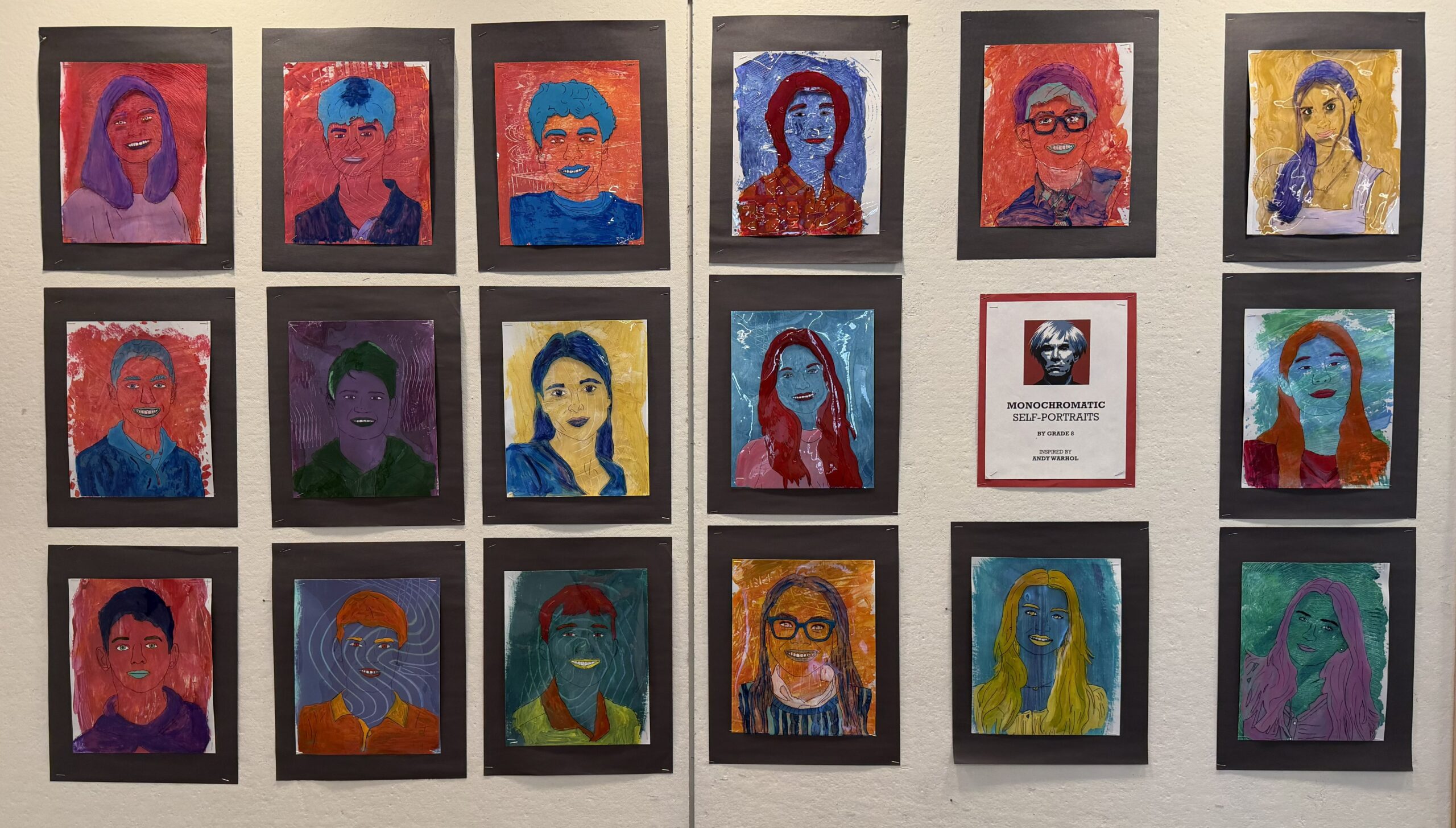
POP ART SELF-PORTRAITS: Andy Warhol was an American artist, film director, and producer who was a leading figure in the visual art movement known as pop art. His works explore the relationship between artistic expression, advertising, and celebrity culture that flourished by the 1960s, and span a variety of media, including painting, silk-screening, photography, film, and sculpture. Some of his best known works include the silkscreen paintings Campbell’s Soup Cans and Marilyn Diptych. Students created inspired self-portraits using a “reverse glass” technique. Selecting an analogous color set for their facial features and an opposite warm or cool textured painted background to contrast and highlight their face.