How does Crossroads Academy teach literacy?
Recently, there has been some discussion about how different schools approach reading, reading comprehension, and writing. Crossroads Academy has long had a strong literacy program that is intentionally and deliberately integrated across all grades, using the Core Knowledge and Core Virtues Curricula as a basis from which to build.
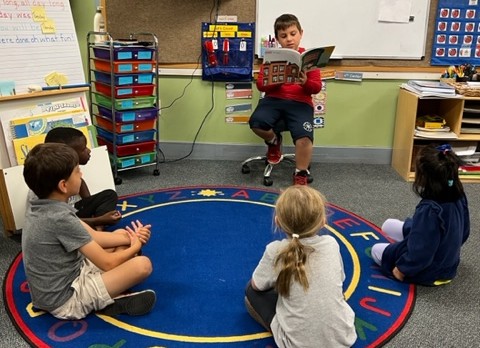
At Crossroads Academy, we believe reading is the gateway to both knowledge and imagination. In the early grades, children master the fundamentals through a structured phonics program, joyful read-alouds, and hands-on practice. As they grow, they are guided into more complex texts where they don’t just decode words—they unlock meaning, ask questions, and connect ideas across subjects. Supported by the Core Knowledge sequence, our students develop the foundational knowledge that fosters comprehension. They continue to build these skills using our beautiful Lora Robins Library, which features a curriculum that aligns with classroom instruction and provides essential library and information skills that support all subject areas by middle school. By then, students are not only confident readers but also thoughtful interpreters of literature and history, engaging in discussions that challenge their minds and nurture their hearts.
Recent findings from cognitive science reveal a compelling truth: background knowledge, encompassing a rich vocabulary and a broad range of content knowledge, is crucial for reading comprehension and deep understanding. Reading ability is not merely about isolated skills, but rather about the knowledge readers bring to a text. According to researcher Paradiso, “knowledge is essential for making sense of texts.” The difference between a “good” and a “bad” reader often hinges on the amount of background knowledge they possess and the extent of their vocabulary. Educational methods that focus heavily on teaching reading in isolation—without investing in building a robust knowledge base—are likely to fall short.
Students don’t just read for skill, but also to reflect on character, respect, and responsibility.
Specifically, in Kindergarten through second grade, teachers use phonics instruction, such as Heggerty and Fundations Language Training, to build phonemic awareness activities that progress into handwriting integration, sight words, and read-alouds. We also use Lucy Calkins Writer’s Workshops. Examples of how we teach public speaking through written text are music performances in kindergarten and first grade, as well as the Insect Show and the State Fair in second grade.
The intermediate elementary grades transition from “learning to read” to “reading to learn,” with guided reading groups, comprehension strategies, Core Knowledge texts, and vocabulary building. Students have opportunities to practice public speaking during the Wax Museum in third grade, the Nature Poetry Slam in fourth grade, and the Persuasive Speech Contest in fifth grade. Throughout these grades, students learn an iterative writing process that culminates with the fifth grade research paper on the Civil War.
The Middle School focuses on literature analysis, close reading, Socratic discussions, and literature circles, which expose students to diverse genres and classic works of fiction, nonfiction, and poetry. Recitations of works by Frost, Dickinson, MLK, and Douglass are key steps in learning rhetorical methods, types of poetry, and public speaking. Middle School students also produce three cross-curricular research papers with the sixth grade writing on The Industrial Revolution, the seventh grade covering genetics, and the eighth grade tackling The Atomic Age.
At Crossroads, literacy is the foundation of knowledge, character, and lifelong learning. Throughout each year at Crossroads, students are growing into confident readers and writers, as well as thoughtful young adults who are prepared to excel in their future educational and professional pursuits. Through the integration of Core Knowledge and Core Virtues, students are prepared to approach the world with curiosity, clarity, and compassion.